
 Telegram

Emotional Amplitude: Four Years Later
When I decided to study the amplitude of emotional experience (AEP) during my bachelor’s degree, I was inspired by the story of A. Maslow: first he developed his theory of self-actualization, and only then did he go looking for people who fit his ideas. I began noticing people around me who seemed to be “living at full volume.” I thought they possessed that tremendous energy of the id Freud talked about. I was obsessed with the idea of measuring existential human passions — the things that stir us and make life feel saturated.
There were plenty of people like that around me. I loved spending time with them and felt a kind of resonance, because deep down I was like that too.
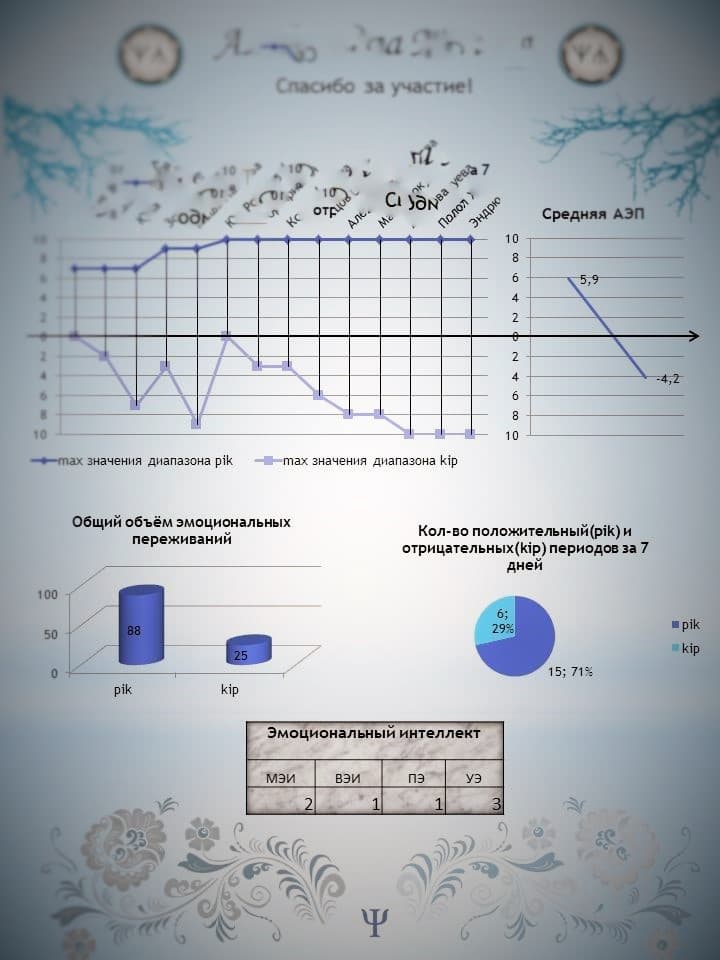
I asked people I knew to record their emotions for a week on a form with a 10-point scale. Three times a day for seven days, they had to place a mark — based on how they felt — on the positive or negative side of the scale and indicate the intensity of the experience. In the end a graph emerged, showing the number of positive and negative periods.
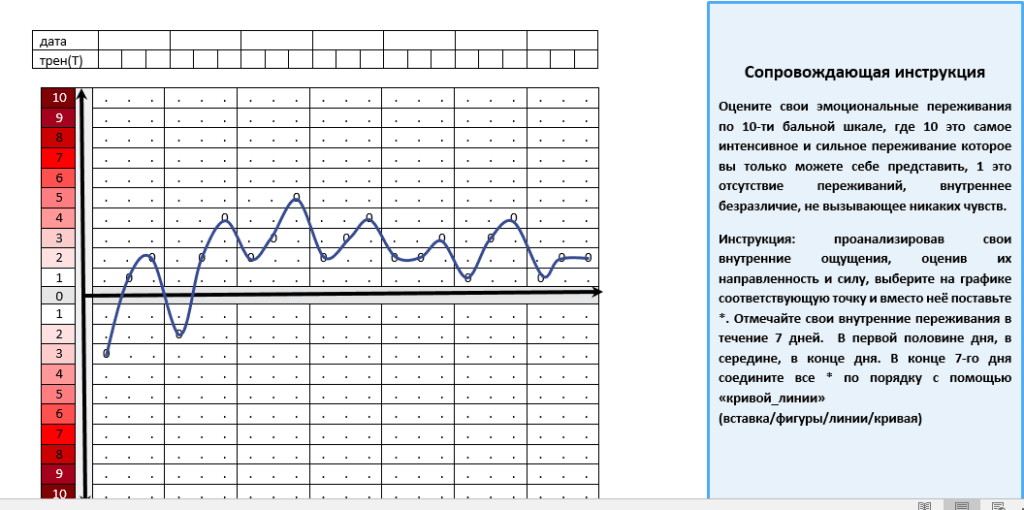
At the same time I began looking for people who lived in a calm, measured way. Two distinct groups emerged. The first had a relatively small AEP, as in the graph above; the second had a large one: their marks reached 8–9, and there were even tens. That second group consisted precisely of the people whose passions I had sensed as strong — in their presence I myself “caught fire,” and with them you could have a hell of a good time.
That is how it worked out: 7 men and 7 women, 14 people in total, and the first group — those with low or medium AEP — had the same number. At first I thought the factor behind the second group’s high AEP was sport: they exercised and trained regularly, while the first group did not. Very quickly, though, I realized it was not really about training (even though the official hypothesis in my research project remained that sport was the factor). Training was a consequence of their restless energy; it simply needed somewhere to go. I knew most of the people in both groups personally and saw what they were like in real life.
The high-AEP group: expressive, charged people. They did not settle for one thing in the different areas of their lives; they tried new things and did not shy away from the “low.” They were little human flames, rebels. They knew how to have fun, and at the same time, if they wanted to do good, they did it wholeheartedly — fully, sincerely. Their amplitude of life was literally large. But there is a law to it:
“If you go down, only go down a little — it expands our life. But if you stay in negative emotions too long, you may not come back.”
S. was one of the people in the high-AEP group. Here is one day with her, and what was going through my head. Diary entry, November 12, 2019:
2:00 a.m. Sitting on the roof after coming back from S.
During training I had this overwhelming desire to talk to S., to tell her about my feelings, my thoughts, about how life is short and moments are worth enjoying. I went to her and told her everything; she opened up to me in return… and at some point I felt fear. Fear of responsibility. I myself don’t know how to live this life.
I am lost. And where am I going to lead anyone — or whom — if I don’t know the road myself?
And this tiny person looks at me with such trusting eyes and is even more frightened than I am, but she does not show it.
And then I thought: I simply have no right to show my fear, because it is my fear, and it will only frighten her more! Then I thought that if I am here in the city, getting to know other people and living among them, then I have no right to abandon them after using them merely as “matches” for my own fire. If thoughts of her gave me so much energy and emotion, then staying with her when I feel bad is my duty — the price I pay for the high emotions that came to me because of her.
In that moment I was a carefree child, accepted simply for existing, and then I became afraid that this would make me weak. Childhood is over, after all, and this world is a world of struggle; with her, though, it was as if I were becoming weak.
Later I felt another incredibly strong emotion when we went out onto the balcony to smoke. There was a full moon. I’m standing there smoking, and this is peak 10 pik*, but it is completely different from what I used to feel out in the field in the village.
- 10 pik — this was my emotional state at the time: 10 out of 10 for the intensity of positive emotion. I was keeping the same graph for myself back then. And the energy of that moment can be explained by the fact that the overall AEP was completely off the charts. Strong coffee, the moon at 2 a.m. — that is the atmosphere I mean.
The feeling of pik — a peak experience. Here the feeling is “raw”: it is like the color of wet asphalt, carrying a certain nostalgia connected with Vyborg.
I’m standing there smoking and looking over the city; inside S.’s room music is playing and she is making coffee.
It is the feeling of adult life, far from the village, but with the taste of a quiet sadness wrapped in possibility, prospects, and power over this world. It is like cold rain, like rime — and somehow you feel proud that you got caught in that rain, even though you are soaked and dirty!
I feel strange right now, as if I have sinned, as if I have stumbled into some vice; it feels… as if my conscience is gnawing at me, even though in reality I did nothing harmful to her or to myself. What is this? Imprints of childhood inside me?
I’ve already been on the roof for half an hour, and I want so badly to be alone inside myself. I had been reaching for what I got today for a long time: at last I touched my own essence, my own heart. The problem of why I am afraid… still, I believe all of this fills me…
Another thought. I am still on the roof, freezing, chilled through, but the peak state is 10 points.
The thought that what I received today — this priceless experience — is this exact experience, one of a kind on the entire planet, across all time. How much had to happen for it to occur, how many elements had to coincide, and how precious this moment is! I am here on the roof, unbelievably happy that I am alive.
That is how much I felt and experienced from just one day with this person!
Without a doubt, high AEP is “an eternal conflict, shadows keep trying to lie down inside doubt, different demons, super-ideas, sometimes the urge to lie beneath granite. Chaos and pain, troubles with yourself. Fear → Freedom → Thanatos → Love…”. See Strength and Light, Chaos and Darkness for more. You could call people like this “hysterical.” Of course — they are alive!
And now, four years later, I think that yes: “before you taste all the delights of your own heaven, you have to taste all the delights of your own hell.” But I also know that you can drown in the hell of pain and meaninglessness so deeply that ending your life begins to look like the only way out. Why does that happen? Why was it not possible to get through those “depressive thickets and cross those inhospitable lands”?
Yesterday I learned that S. had died. It was suicide.
………………
And if there had been an Other in those thickets — a psychologist, or simply someone close — could they have created Light there?
Could they have said that this burden was temporary, that everything passes, and walked beside her toward a place everyone must visit, but from which not everyone manages to return?
I wish so much that I could do everything possible for the darkness to run dry, and for the fruit of the struggle with evil to bring something valuable into our world — because she was a beautiful person.
Safety note: if thoughts of suicide or self-harm concern you right now, tell someone you trust and contact a doctor or mental-health professional. If you are in immediate danger, contact local emergency services or a crisis line. WHO guidance.
Questions about this article
01What does emotional amplitude mean in this text?
It is the author’s way of observing the range and intensity of positive and negative emotions over a week; the post describes a personal student study, not a clinical diagnosis or validated typology.
02Do intense emotions necessarily mean a fuller life?
The text presents an ambivalence: intensity can feel like energy, closeness, and vividness, but it does not in itself protect a person from pain, loss of meaning, or self-destruction.
03How can someone support a person in a suicidal crisis?
Speak directly and without judgment, listen, help the person reach professional care, and if danger is immediate, do not leave them alone and contact emergency services or a crisis line.