
 Telegram
The Day an Idea Became a Physical Object
The Day an Idea Became a Physical Object
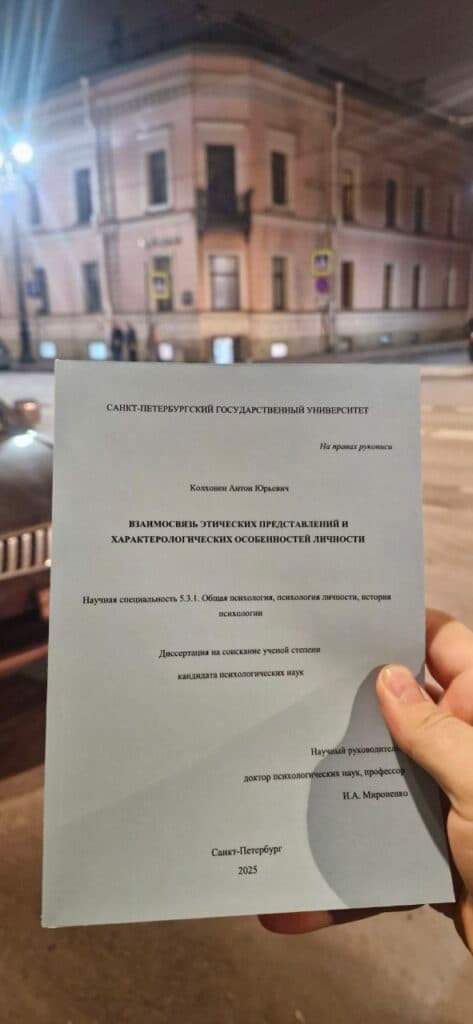
Today, for the first time, I am holding my dissertation in my hands. Not a PDF, not a document you open on a laptop, but a real, thick book from a printing house. One hundred and eighty pages, a cover, weight, the smell of paper. Funny thing: while I was leafing through it, I automatically started joking—go check the bookstores, look in the psychology section, order it on Ozon. Then I caught myself thinking that I would actually say that seriously… if it were not academic.
But this is exactly the point where two lines came together for me: what already exists and what comes next. The dissertation is the foundation, the core, the load-bearing structure. The house you can build on top of it is another story entirely. A story with personal experience, living examples, moments of doubt and inspiration, stories of people, encounters, and inner change. Stories that make the reader walk beside you rather than merely move their eyes across the page. ✧
Howard Schultz
And Howard Schultz’s words fit this moment particularly well. I want to quote them in full, because pulling out a single sentence would almost be a crime against the meaning:
“But I dared to dream, and then I wanted to make my dreams real. I am convinced that most people are capable of reaching their dream—and even going beyond it—if they are firmly determined not to give up. Second, and even more importantly, I hope to inspire leaders to aim higher. Success is nothing if you cross the finish line alone. The best reward is to reach the finish surrounded by winners. The more winners who arrive with you—employees, customers, shareholders, or readers—the greater the satisfaction your victory will bring.”
That thought hit me hard once. Any work, after all, begins with an idea. An idea lives in your head; it seems fragile, maybe even doubtful. But if you do not let it go, if you give it room to grow, if you dare to dream—one day there comes a moment when you are holding in your hands the material form of what used to be only an inner spark. For me, this is exactly that moment.
But Schultz has a second line there too: the people around you. A real victory is when you do not reach the finish alone. In that sense, the reader is a kind of co-author too. A reader needs a story. They want to see the road. They want to know how the idea began, what stood beneath it, what values and principles ran through it.
And values and principles are precisely what my dissertation stands on. They are its foundation slab. That is why I can look ahead fairly calmly: style, publicistic writing, narrative—those are the superstructure. Difficult? Yes. But doable. We are moving there gradually, step by step, without making grand vows. As the saying goes… never swear off the beggar’s bag if you’re Birkin, or prison if you’re Girkin ☝️🙂
And still, something tells me that this story has a continuation. One that, someday, I will want to hold in my hands too. Maybe not right away. But the idea is already alive. And that is the main thing.
━━━━━━━━━━
Join the discussion on
Questions about this article
01What does “the day an idea became a physical object” mean?
It is the day Anton Kolhonen first received a printed copy of his 180-page dissertation. A research idea that had previously existed as a PDF and working text acquired the physical form of a book, complete with a cover, weight, and the smell of paper.
02Which dissertation does the post describe?
The photograph shows Anton Kolhonen’s dissertation, “The Relationship Between Ethical Conceptions and Characterological Personality Traits,” prepared at Saint Petersburg State University for the Candidate of Sciences degree in psychology in 2025.
03Does the author present the printed dissertation as a finished book for general readers?
No. The joke about bookstores and Ozon is immediately qualified by the fact that this is an academic manuscript. The author describes the dissertation as the foundation for a future book that would still need personal stories, examples, and a more public-facing narrative.
04Why does the post quote Howard Schultz?
The passage from “Pour Your Heart Into It” joins the post’s two themes: persistently turning a dream into reality and sharing success with other people. The reader therefore appears not as a passive observer, but as a participant and potential co-author of what comes next.