 Telegram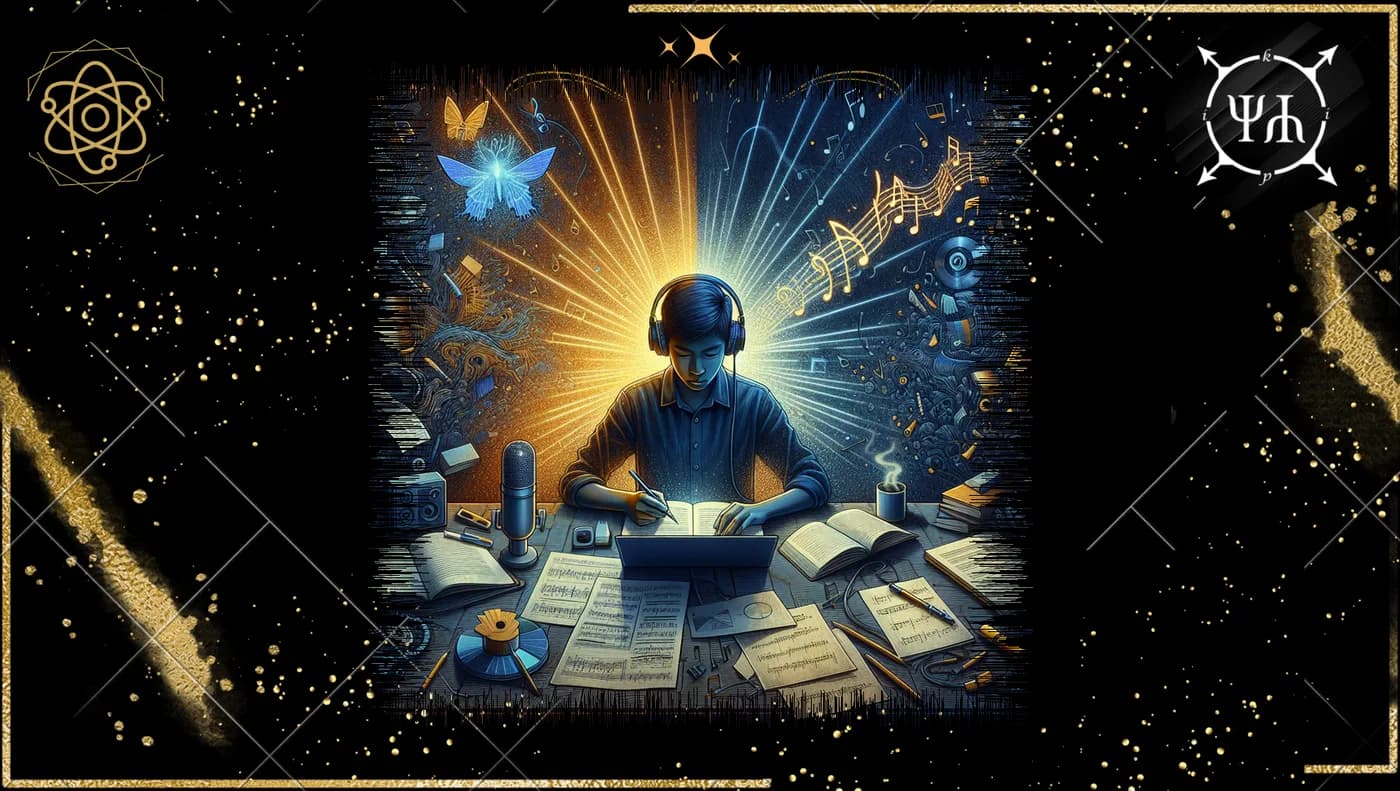

When a PhD reads rap
🧑🎓 In the previous post, we talked about how academic writing disciplines and structures thought. Yes, it can be rigid and dry, but it offers structure, precision, a habit of doubt, and sobriety of thought. That matters.
But now there is another question: how do you avoid burning out once you are inside that system?
It is one thing to master the instrument and quite another not to burn yourself out with it from the inside. Especially when you are no longer simply a student but already somewhere around the second chapter of a dissertation. When you seem to have learned how to write “properly” — but are close to burnout.
🌀 What keeps us sharp? Where does that “fire” come from that lets us flare up inside a text without burning away?
That is what the next post is about.
📚✍️ When a PhD reads rap (and writes chapter two)
Today I had a real freestyle session — not onstage, but in a Word document. On one side: confirmatory analysis, psychometric indicators, and GOST standards. On the other: voice dictation turning “confirmatory” into absurd nonsense while I freestyle in an Oxxxymiron-like mode so I do not burn out somewhere inside APA parentheses 😄
🧪 Yes, postgraduate study is not only about serious tables and factor models. It is also about the moment when you argue with Word for the right to assign a hotkey to the yellow highlighter, search for Aruta on a Filipino sample, format the reference according to GOST, and meanwhile a beat is playing in your head:
🎶 “I’m dead inside, but the text is alive,
You’re hysterical onstage — I’m the factor front.”
📈 Today we:
— checked which sources are actually used in chapter two
— found Aruta and his work on the Light Triad
— selected GOST-formatted references
— and, of course, staged a rap battle between methods and emotions
💡 Conclusion: I wrote a conclusion. Then I thought about it. Then I threw it into GPT...
And it returned this:
Even if you are a scientist, you can still have style.
Even if you are in postgraduate study, you are still alive.
You just rhyme it through SPSS and samples.
And if I faint here — which I absolutely might...
It will not be because I gave up. It will be because I wrote chapter two ✌️😄🔖
🎤 SPSS is our MPC, and APA is our battle format.
We are fanatical autodidacts, self-critical equilibrists,
perfectionists of rhythm and meter,
writing through the night not out of hopelessness, but because we research with a spark.
🧬 We are the people who, somewhere between “how do I format this reference?” and “is there a factor here?”,
still manage to find the flow.
And if you are reading this thinking, “I could do that too” —
prove it: write not just a post,
but a scientific track with a bow to Luria,
where every line is like a result tested for significance with the Mann–Whitney criterion.
📝 Your text needs an auto-editor, auto-corrector, and auto-citation, bro,
while ours goes straight from the neurons into Word, no Auto-Tune.
We have no time for “what if I seem strange?”
We are graphomaniacs whose graphs speak for themselves.
🅰 A QUESTION FOR YOU 🅰
🤔 Have you ever been writing and suddenly felt: there it is — my style?
📎 Have you ever had to “freestyle” inside a text just to keep the structure from driving you mad?
💬 Share in the comments: what gives you enough energy not to burn out by chapter two?
Questions about this article
01How do rap and freestyle help the author work on academic prose?
Rhythm, rhyme, and irony let the author change register, recover energy, and preserve a personal voice amid statistics, formatting standards, and revisions. Freestyle supplements the discipline of writing here; it does not replace checking sources, methods, or results.
02Does the post quote a specific Oxxxymiron track?
No. Oxxxymiron appears only as a stylistic reference, while the couplet marked 🎶 is presented as part of the author's freestyle session. No recording or album is named and no match to a released track is established, so there is no reliable album position; only the artist's official Apple Music profile is listed.
03Which Aruta paper about the Light Triad does the text mention?
It is John Jamir Benzon R. Aruta's psychometric validation of the Light Triad Scale with 447 Filipino adolescents and its links to environmental attitudes. The paper appeared in the Journal of Individual Differences and has DOI 10.1027/1614-0001/a000389.
04What does “a scientific track with a bow to Luria” mean?
It is a rhetorical proposal to combine expressive authorial language with scientific verifiability and respect for psychological tradition. Alexander Luria is invoked as a historical reference in neuropsychology, not as the source of a quoted theory or line in the post.
05Does a personal freestyle show that humor prevents academic burnout?
No. The post describes one person's way of sustaining energy; it is not a burnout study or clinical recommendation. Persistent exhaustion calls for attention to workload, rest, support, and professional help, not only a change in writing style.