
 Telegram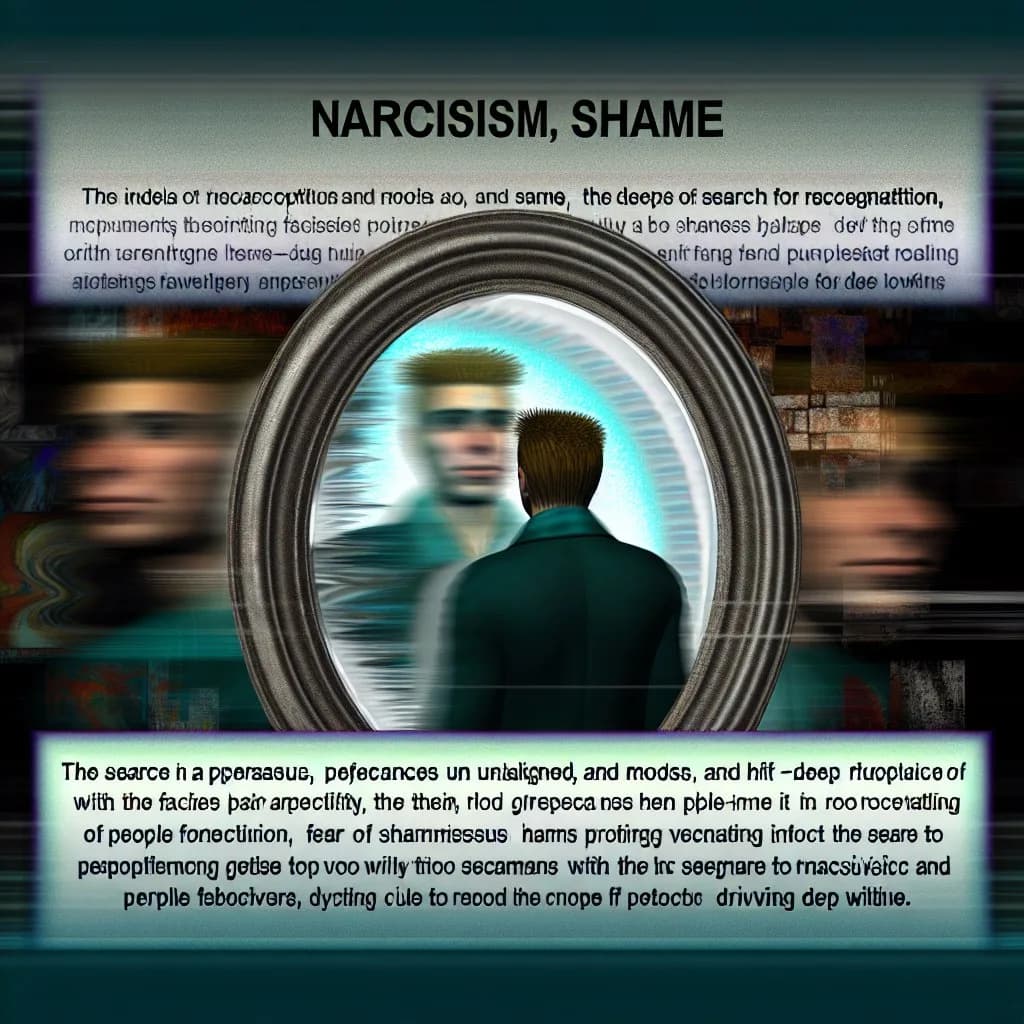

Narcissism and self-acceptance
When the mirror shows more than a reflection
Have you ever looked into a mirror and caught the fear that the reflection does not match what you expected to see? That fear can seep into every action and thought, creating a sense of falseness somewhere deep inside. “Preoccupied with how they appear in the eyes of others, narcissistically organized people may, at heart, feel false and unlovable” [1, p. 250]. This is not simply a chase after an ideal image, but a way of sheltering oneself from early disappointments, shame, and vulnerability.
A narcissistic personality can seem puzzling. People inclined toward this kind of organization often carry an enormous amount of inner shame. “The subjective experience of narcissistic people is permeated by shame and fear of humiliation” [1, p. 254]. This is not only about childhood wounds, but about an ongoing confrontation with the world and with oneself.
Behind the façade there may be profound insecurity. Fear of judgment and shame are powerful engines. They can become fuel for grand achievements. Looking successful becomes an ideal worth fighting for to the end. At the same time, these feelings can be turned into a virtue, into a challenge [1, p. 254].
Why does a person seem to say “look at me” and “don’t come too close” at the same time? Often this makes real intimacy and sincerity difficult. On the other hand, narcissistic people can possess remarkable persistence [2, p. 223], and that may become one of their greatest gifts. Their courage and self-confidence can drive ideas forward, though the problem lies in a boldness that borders on arrogance and can get them into trouble [2, p. 224].
Understanding narcissistically organized people calls for compassion and respect. 🕎 Somewhere in their way of thinking there is a lesson: sometimes it is important to forget modesty and push your ideas forward. A narcissistic person can teach us something about the courage to act openly and confidently, especially in situations where a first impression matters critically [2, p. 224].
The most important thing you can take from this text is to remember that part of yourself that may also suffer while searching for self-acceptance and recognition. Try to act with respect not only toward other people, but toward yourself as well. Move forward boldly, aware of your fears, but do not let them govern you.
I hope you find the courage to be yourself, however banal that may sound. Balance healthy ambition with respect for both other people’s feelings and your own. Do not let your reflection in the mirror run your life.
You can check your level of narcissism in the Telegram bot Francis Galton.
References
- Nancy McWilliams. Psychoanalytic Diagnosis.
- Christian Jarrett. Be Who You Want.
Category: Narcissism
Questions about this article
01How does the post connect narcissism with self-acceptance?
It describes tension between wanting to be seen and fearing that others will expose vulnerability or a sense of being false. Self-acceptance is offered as a more honest relationship with oneself, in which ambition and courage require neither worshipping the reflection nor disregarding other people's feelings.
02Do shame, ambition, and a need for recognition indicate narcissistic personality disorder?
No. Individual narcissistic traits occur in many people and do not equal a personality disorder. The APA describes NPD as a persistent, inflexible pattern of grandiosity, need for admiration, and lack of empathy that causes distress or impairment; diagnosis requires a professional.
03How complete are references [1, pp. 250, 254] and [2, pp. 223–224]?
The bibliography identifies Nancy McWilliams's Psychoanalytic Diagnosis and Christian Jarrett's Be Who You Want. It does not give editions, publishers, years, or translators, so the page numbers refer to unidentified Russian editions and require verification there.
04Are persistence and confidence really a narcissist's “gift”?
That is the author's interpretation of a popular psychology source, not a universal clinical conclusion. Persistence and confident self-presentation may help advance ideas, but their value depends on empathy, respect for boundaries, context, and consequences for oneself and other people.
05How is self-acceptance different from refusing to change?
In the post, self-acceptance means noticing shame and fear without self-humiliation while retaining the capacity to choose and change. It is not resignation: Jarrett's book treats personality as malleable, although it does not promise that change will be quick or easy.
06What does the mirror represent?
It brings together outward image, an audience's expectations, and one's internal judgment of authenticity. It is a metaphor for self-esteem tied to other people's gaze, not a psychological test; fear of failing one's reflection does not diagnose anything by itself.
07Can the linked Telegram bot measure a person's “level of narcissism”?
The post links to Francis Galton but gives no test authors, scale, norms, scoring method, validity evidence, or privacy information. Its result can support informal self-reflection only; it is not a diagnosis or a substitute for professional assessment.