 Telegram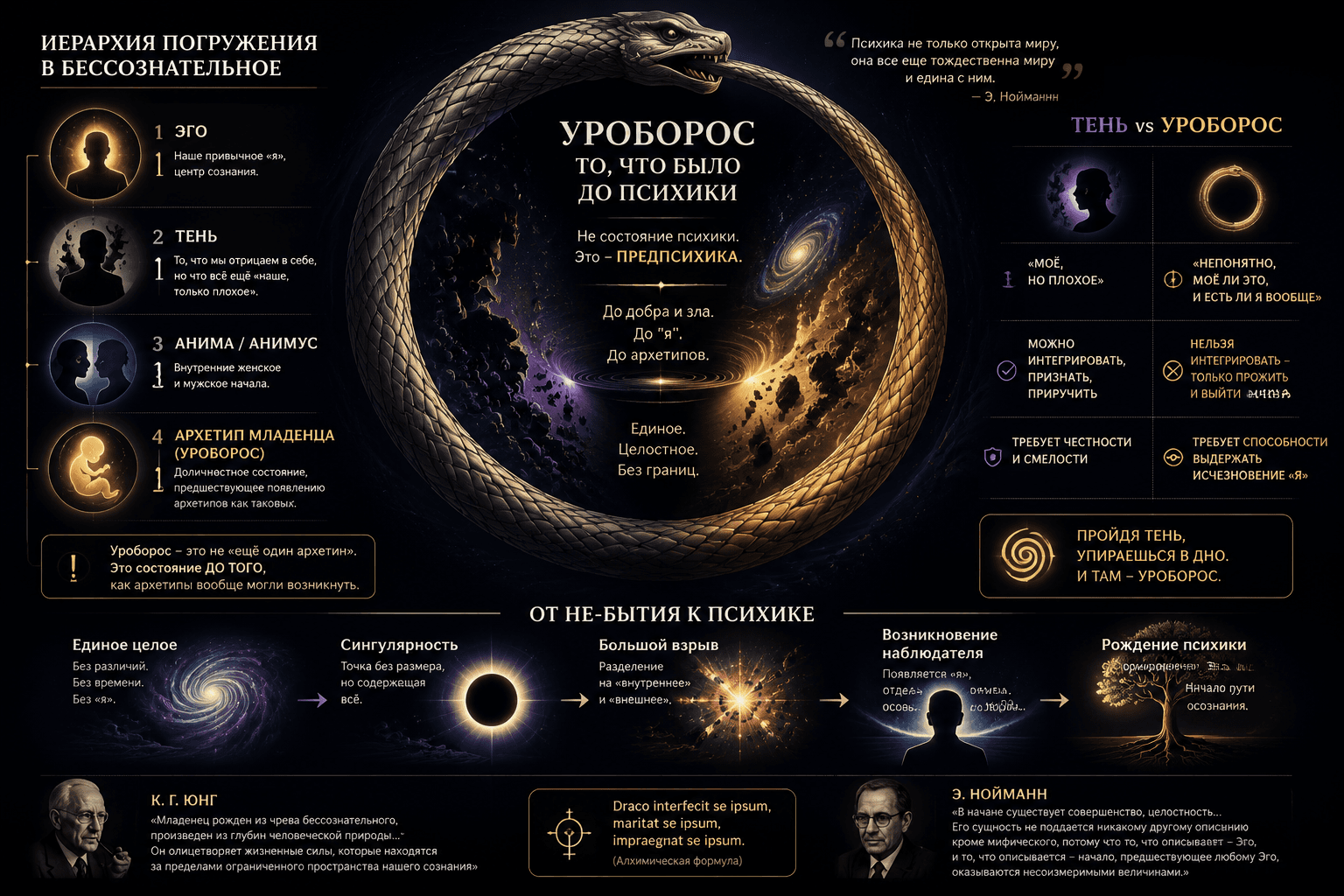

Ouroboros, or What Came Before the Psyche
A personal prehistory
A year of work in a therapy group was coming to an end. At the finale we wrote about one another: everyone about everyone else, collecting epithets, images, and metaphors that resonated with what the group had seen in each participant over all that time. Among the many descriptions I received, there was one that delighted me: “Ouroboros.”
I had read Jung and knew his theory of archetypes, but I had never heard this term before. Then I read about it — and everything fell into place.
By that point I had already done a lot of work with the Shadow: examining how it showed itself in me, exploring the edges of good and evil through dialectics, learning to notice what I was used to denying. The Shadow is “mine, but bad.” It can be integrated, acknowledged, tamed. But the image the group gave me pointed somewhere else. Toward what lies before good and evil. Toward a place where there is not even an “I” capable of distinguishing one from the other.
That is how Ouroboros appeared in my inner space — the bottom you reach after the Shadow has been “passed through.”
1. The ancient symbol: where it begins
Ouroboros (from Ancient Greek οὐροβόρος, “tail-devouring”) is an ancient symbol depicting a snake or dragon biting its own tail. One of the earliest known Egyptian examples appears on Tutankhamun’s second gilded funerary shrine and dates to the fourteenth century BCE.
The symbol is a unity of opposites:
- beginning and end coincide;
- creation and destruction are fused in a single movement;
- life and death are one and the same.
In alchemy, it was described this way:
Draco interfecit se ipsum, maritat se ipsum, impraegnat se ipsum.
It is male and female, begetting and conceiving, devouring and giving birth, active and passive, above and below — all at once.
2. Jung and Neumann: from symbol to the infant archetype
Carl Gustav Jung gave Ouroboros a new psychological dimension. In analytical psychology, this image is connected with the archetype of the child.
The child is born from the womb of the unconscious, produced from the depths of human nature… It personifies life forces that exist beyond the limited space of our consciousness.
For Jung, the child archetype is not a literal child but a symbolic designation for a condition before the birth of the conscious “I.” It is a “possible future,” “that which paves the way for a change of personality.”
Jung’s student Erich Neumann developed this idea into an entire stage model in The Origins and History of Consciousness. He called it the uroboric stage — the earliest stage of psychic development, in which the Ego still belongs entirely to the unconscious.
In the beginning there is perfection, wholeness. This original perfection can only be “designated” or described symbolically; its essence permits no description other than the mythical, because what is doing the describing — the Ego — and what is being described — the beginning that precedes any Ego — are incommensurable quantities.
3. Ouroboros in the hierarchy of archetypes
If we try to arrange a provisional hierarchy by depth of descent into the unconscious, it looks something like this:
- Ego — the top layer, our familiar “I.”
- Shadow — what we deny in ourselves, but what is still “ours, only bad.”
- Anima / Animus — the inner feminine and masculine principles.
- Child archetype (Ouroboros) — a pre-personal condition preceding the emergence of archetypes as such.
Ouroboros is not “one more archetype” among the others. It is the condition of the psyche before archetypes could emerge at all. And to be even more precise, it is not quite a condition of the psyche either. It is pre-psyche.
There is as yet no thinking, self-aware Ego that could relate anything to itself — that is, reflect. The psyche is not merely open to the world; it is still identical with the world and one with it.
4. Shadow vs. Ouroboros: the fundamental difference
This distinction is the key:
| Shadow | Ouroboros |
|---|---|
| “Mine, but bad” | “It is unclear whether this is mine — or whether there is an ‘I’ at all” |
| Can be integrated, acknowledged, tamed | Cannot be integrated — only lived through and exited |
| Requires honesty and courage | Requires the capacity to endure the disappearance of the “I” |
Once you have passed through the Shadow, you hit the bottom. Ouroboros is there.
5. The difficulty of describing it: there are no contours
Any description of Ouroboros runs into a fundamental problem: the moment we give it an image or make it an object of reasoning, we create contours. This state has none.
It is almost hopeless to tear a single archetype out of the semantic fabric of the psyche… To draw a clear boundary and give exact conceptual formulations in this field is positively impossible, because the essence of archetypes lies in the way they flow into and through one another.
So Ouroboros cannot be described literally. We can only approach it through metaphors, symbols, and analogies.
6. The main analogy: singularity and the Big Bang
The most precise analogy I have is cosmological:
🐍 Ouroboros = the singularity before the Big Bang.
No space, no time, no laws. Only pure potential.
💥 The birth of the “I” = the Big Bang.
An observer appears — and with the observer, a world appears.
🌌 Shadow, Anima, Self = an already structured universe with galaxies, laws of physics, and causal relationships.
In the uroboric state, you cannot “see” anything in the ordinary sense, because there is no one there to see. No subject and object. Only an undifferentiated field.
Editorial clarification: the “hierarchy of descent” below is the author’s symbolic interpretation of ideas from Jung and Neumann, not a validated diagnostic or therapeutic model. Depersonalization and derealization are not desirable goals of practice or evidence of “contact with the pre-psyche.” Persistent, recurrent, or distressing episodes need professional assessment; deliberately inducing them is unsafe. See overviews from the NHS and MSD Manuals.
7. What happens if a personality tries to “dive” into it
If you try to dive into Ouroboros while preserving the familiar position “I am me, the one observing,” there are two possible outcomes:
- a wall — the psyche will not let you go farther; it protects itself;
- depersonalization — a temporary loss of the sense of “I,” when the observer itself disappears.
This is not meditation in the usual sense, and not merely an altered state of consciousness. It is the disappearance of the one who could have experienced the state.
8. Why go there at all, then?
A fair question. If Ouroboros cannot be described, seen, or integrated, what is it for?
The answer: deliberate destructuring.
Imagine you have built a house. You live in it; it works for you. Then one day you decide to take it apart — not because it is a bad house, but because you want to understand what it is actually made of. You inspect every part, every material, every joint. You look at the space itself that used to be inside. And then — you assemble it again.
Ouroboros is not something that should be “used” constantly in therapy. It is something that can be felt once, at the limit, at the edge — to understand the ground from which everything else later takes shape.
It may be especially relevant when:
- familiar ways of working with yourself have stopped working;
- a client has reached a dead end that does not unravel through integrating the Shadow;
- the task is not to “improve” the personality but to return to its origins.
But a warning: I am not sure this process can be initiated from the outside simply because someone asks for it. Ouroboros does not obey instructions.
9. The main warning: you cannot work with it as if it were the Shadow
The Shadow can be integrated. Ouroboros cannot.
It can only be lived through — and exited.
The very form of the symbol points to this: the snake biting its own tail is psychic autophagy, a process in which the psyche begins digesting itself. 🌀
The serpent devouring its own tail is a symbol of cosmic dynamism, the circulation of the universe, the unstoppable “wheel of life.” It is a synonym for the Cosmos itself, for the Universe insofar as it is defined by the turning of this wheel.
In this state the psyche cannot develop — it simply chews itself over and over in an endless cycle. That is why one must not get stuck there. But to sense this level, if it opens up, can be useful. Though difficult.
There may be a feeling of “flying away” or losing one’s point of support. This should not automatically be treated as normal or as evidence of a “pre-psyche”; intensity, recurrence, distress, and effects on daily life are what matter clinically.
10. Practical conclusion
What do you do with Ouroboros if it appears in therapy or in a group?
- 🚫 Don’t get stuck — remember that autophagy must not become a way of life.
- 🙏 Don’t be afraid — but treat it with respect.
- 🎨 Translate it into creativity — draw it, sculpt it, write it down, dance it.
This article is based on personal therapeutic experience and on the works of C. G. Jung (The Soul and Myth: Six Archetypes, “The Psychology of the Child Archetype”) and E. Neumann (The Origins and History of Consciousness).
Questions about this article
01What does Ouroboros mean in this text?
The author uses the ancient image of a snake biting its own tail as a metaphor for undifferentiated wholeness before a stable conscious self.
02How does Ouroboros differ from the Shadow in the proposed model?
This is the author’s reading of Jung and Neumann, in which the Shadow belongs to rejected parts of an existing self while Ouroboros marks an imagined boundary before that self forms; it is not an accepted clinical hierarchy.
03Is depersonalization a goal of this kind of inner work?
No. Depersonalization and derealization are clinical symptoms, not proof of experiential depth; recurrent or distressing episodes warrant professional assessment.