
 Telegram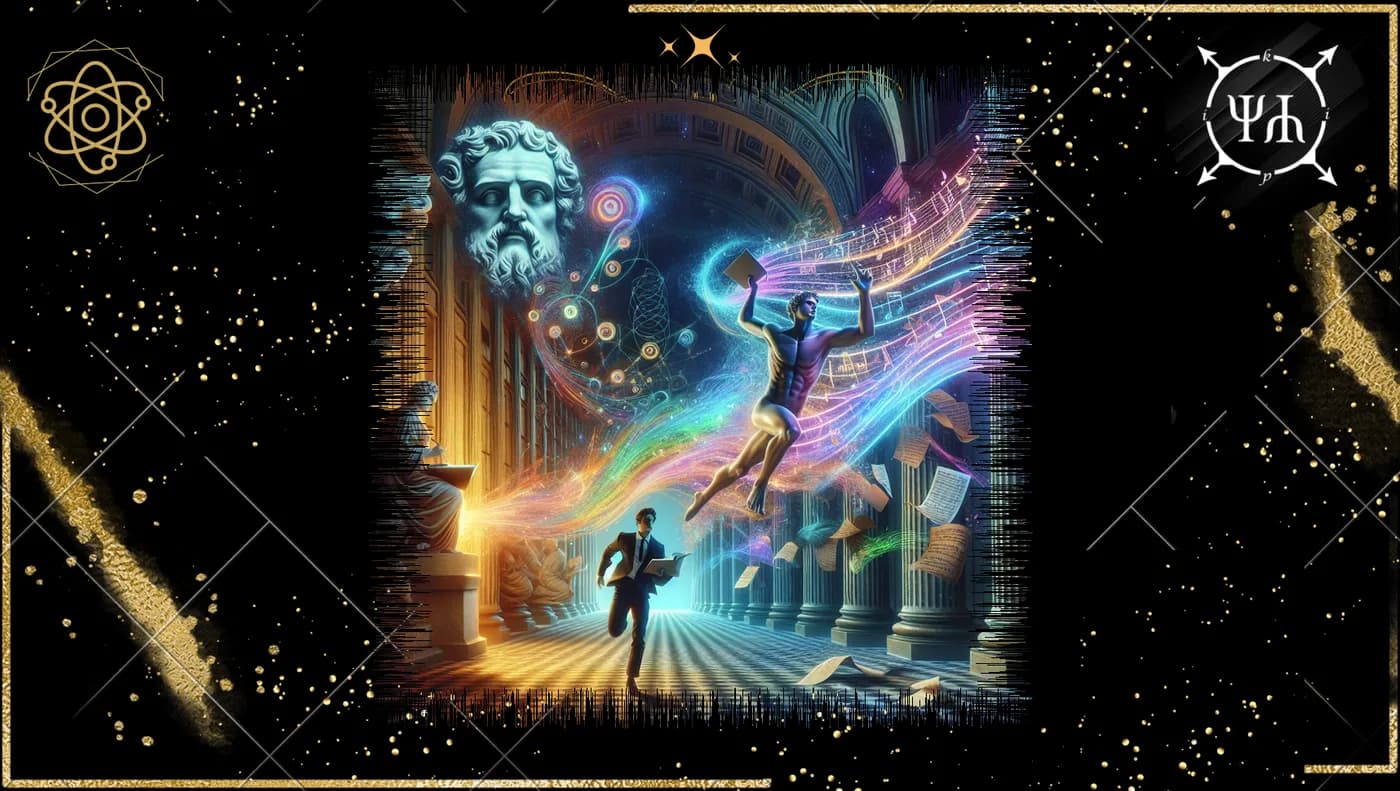
Beyond Academic Writing. Part 2
As Machiavelli showed in The Prince, even the most important and dangerous thoughts can be delivered at a bright, brisk tempo — Allegrissimo. That contrast, that dynamics, is the essence of living writing. 🎶 This is exactly what a change of tempo is: a sharp turn, like in music or a sprinter's burst — and it becomes the first step toward escape. Because if academicism has shackled you, rhythm may be precisely what sets you free, like a beat at 140 BPM. 🤘
With Nietzsche, too, there is always room for celebration inside the storm of reason:
I am close to Machiavelli's tempo, which in his Principe (The Prince) makes one breathe the dry, pure air of Florence; which is compelled to present the most serious things in an untamable Allegrissimo, perhaps not without a mischievously artistic sense of the contrast it dares: long, heavy, severe, dangerous thoughts — and the tempo of a gallop! And the merriest of moods.
It was precisely this tempo, this half-play and half-fantasy, that helped me not burn out while writing scientific prose. When you feel your thoughts getting bogged down in templates, sometimes you simply need to change the rhythm. Perhaps even go mad — but consciously. 💡
🅰 THE TEMPO OF THOUGHT: FROM FLORENCE TO PSYCHOSIS 🅰
An imaginary dialogue. A young postgraduate student meets their supervisor and introduces himself:
Supervisor:
You're “far from Chapa, so learn your damn basics!” 🎶
Want Gorgorod burned down — Notre-Dame de Paris?
Your theories are schizo, like Guattari!
Student: I'm full of energy. I want to set a handball record!
Supervisor:
What handball record?
Just don't starve to death: corporations, pharma, gurus jack up prices — the sums would make you lose your sh...!
Student: But what about curling, golf, and the racetrack?
Has everyone forgotten those?... makes you want to climb out the window — Yegor Pogrom 😒
Supervisor:
Of course! Thought you were a cool beaver, trendy Bo Burnham?
Your ego, your testing ground — a fake, not the original.
You're a Mormon, I'm the guru — your Ferdinand Demara... So what, are you with me? 🎶
........
3 YEARS LATER
Thoughts of a still-living postgraduate student who did not abandon his “schizo-theory” and absorbed all the wisdom of the learned elders — a formidable mixture. Picture it: the student walks out of his alma mater, filled with deep knowledge (but still never learned grammar 🧹), looks at the world, and says in his heart: (read it fast, at a galloping tempo, like 140 BPM)
—
Maybe popular science lies? And maybe after I die an ignorant priest won't sing my funeral rite?
My meeting with death is adultery.
After I leave the morgue, she'll need an obstetrician.
Lucifer, Capital, death beneath me — Bucephalus.
Danse macabre and Charon: from the ship straight to the ball.
So what is beyond the line? Thick darkness,
like Cousteau's expedition — everything drowning in the blue abyss.
Or karma keeps the score: which turn of samsara is this?
Fool, rookie, novyiop — so what?
And Husky–Feduk on repeat in hell, and my corpse — MaddyMurk,
a pale shadow in the coffin, like Bely Andrey.
Hell is my Petersburg, where Beglov is the Holy Spirit.
Or some quantum trick will fling you back into dreams:
you'll wake as a night butterfly, like Zhuangzi.
The pathologist, like Jean-Claude in his bloody sport,
works over you, picking through guts in search of the soul. 🎶
(Here the postgraduate student, burdened with knowledge, asks questions about the meaning of life. He doesn't believe... and he substantiates it, exactly as he was taught: so that nobody understands, but it looks clever.) Yet he realizes even this and continues speaking in his heart:
If that's how it is, then at least “remember the last kiss, the last min... Oh, that's vulgar... But
no one escapes these pitchforks, every modern geneticist says so” 🎶
This is our genesis, like kidnapping.
...THEN THE TEMPO OF THOUGHT ACCELERATES — PSYCHOSIS APPROACHES!
I enter primordial darkness humming “Macarena”.
I'm not on Roizman's run, but f**, I see the mayor.
I'm no Castaneda with Don Juan, but I see the guru.
As if I'd swallowed a barbiturate: the Greek puts his hand into the river.* 🎶
But he stops. Long before postgraduate school, life had already led him along the edge. And he knows, almost like anyone who lives near a border, how to stop at the edge. This kind of mental walking along ground that has neither been ploughed nor sown guarantees that you, dear reader, won't be sold a third-rate remix of Yesenin 🎶 or served some stupid banality — something already worn out, something you can simply Google. Like: “How do you work with clients who have BPD?” ... Ha... well, well... good luck if you plan to rely only on theory when working with them. 🧑🔬🔖
🅰 DEAD PRECISION 🅰
But what about those who write by the rules? What about those who cleanse thought of life itself, leaving only a sterile, lifeless shell? Words in academic writing become “dead”: they lose their flexibility, become hard and numb. They turn into... a conceptual apparatus. Apparatus... apparatus...
And this is where the tragedy begins: the words become flawless, but there is nothing left to fill them with.
Yes, many admire the precision and clarity of academic writing, but the words do not strike the soul, do not touch the heart, and become something like dead bodies lacking breath.
Those who write by these rules become librarians and proofreaders. They go blind from book dust, lost in the captivity of precision and typos. 🔬
🅰 DISCOURSE — THE NEW GOD OF ACADEMICISM 🅰
And then a new god arrives — Discourse. It weakens like old folklore, like a ritual turned into empty formality. Discourse replaces the Demiurge and Dionysus: the sterile, barren god of the academic world. In place of Dionysian force comes tired, dead order. 🏛️
We assume that the university is a dwelling place of creativity because our best minds are gathered there. We expect teachers and students to exercise all of their creative capacities. Yet here too we are dealing with creativity that can be managed and controlled...
It is no accident that many of humanity's greatest achievements and fundamental discoveries were made not in the best universities but by people who were then working either independently or within small unorthodox institutions. Examples? Einstein, Freud, Gandhi, Marx, Darwin, and Edison. They all worked either independently or in small temporary institutions such as Freud's Vienna institute or Edison's laboratory. The origins of modern visual art and literature lie not in universities, but in the avant-garde movements of the beginning of the century, such as the Bauhaus.
🅰 CREATIVITY OR COUNTERFEIT? 🅰
And so in an academic world where everything is subordinated to strict laws and rules, there seems to be no room for living, passionate ideas. There is no place for the pain of change, for tempo, for emotional intensity. Only faultless words matter — not what they carry. 📊 For example, every six months postgraduate students submit reports that meticulously record whether two articles were published, whether 30% of the text was written, whether enough sources were analyzed. Yet not once in all these years has anyone asked about meaning. Nobody asks about the idea, the intention, the pain, or the discovery. The important thing is to match the format. Complete the plan. Everything else is outside the reporting system. And this isn't chemistry or physics — this is psychology!!! So let's be honest:
Your higher education in psychology is like Kirkorov's diploma — a worthless scrap of paper. 🎶❗❗❗😄
And the louder the choir of your publications becomes, the quieter the voice of the living spirit sings inside — the same voice that once led you by the hand through ideas, words, and lines.
So decide for yourself:
Do you want to become one more neatly combed figurine in the museum of academic wax? 🕯️
Or break free while you still can — with disheveled thoughts, burning blood, and eyes
that look not at the letter,
but at the boundless sea of meaning. 🌊🔥
🅰 TO BE CONTINUED 🅰
In Part 3, we'll talk about meaning, language as spirit, and whether living speech can be returned to academic writing. See you there.
Sources 📚
- Nietzsche F. Collected Shorter Works. St. Petersburg: Azbuka, 2017.
- Farson R. Management of the Absurd. Kyiv: Sofia, 2001.
- Excerpts from Oxxxymiron* tracks (marked 🎶).
- Slava KPSS. Album GORGOROD 2, tracks “Rave Ezoterika” and “Slovo Mera 2” (marked 🎶).
* Designated a “foreign agent” in Russia.
Questions about this article
01How can rhythm preserve living thought in academic writing?
A change of pace breaks the monotony of a template and restores freedom to the movement of thought. Musical rhythm, contrasts between short and heavy phrases, and unexpected turns help sustain attention without reducing a scholarly text to mechanical compliance with form.
02Does precision in academic writing guarantee meaningful content?
No. Error-free wording and correct reporting can exist without a strong idea. The text criticizes situations in which measurable outputs displace questions about purpose, discovery, and the human meaning of research.
03Why can a controlled academic environment constrain creativity?
When creativity is subordinated in advance to reports, quotas, and permitted forms, safely reproducing the familiar becomes more rewarding than risking a new idea. This is a critique of an extreme, not a claim that universities can never support creative work.