
 Telegram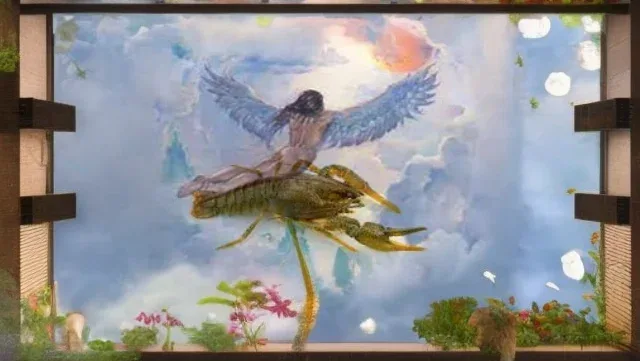

Parable: Icarus and the Crayfish
Parable: ICARUS_and_the_CRAYFISH
The inhabitants of the Greek island of Ikaria in the Aegean Sea, for whom reaching one hundred is nothing unusual, follow a healthy diet and engage in moderate physical activity — and this plays its part...
And all of us keep backing away like crayfish — Icarus in reverse*. 🔄 So here goes:
I_and_the_Crayfish arrived — and Ikaria received her guests.
On the island of calm, suddenly the Ego
created anxiety, fuss.
IT, moving like a hermit crab 🦀,
searches for an exit through dependent behavior.
The psyche is like a stripped electric wire —
hears “ha-ha” and thinks the laughter is at him!**
All of this shook the Blue Zones Solution 👌
And so the story of people began.
A broad soul — to avenge the humiliated
and insulted —
here comes the basic instinct***.
An ancestral wound will not let us rest,
but while there are stars above Pantelleria,
we will forever see the Virgin Mary's eyes in them.
The animal keeps hiding inside,
and the sun shines on everyone, whoever they may be.
Thus our soul was split in two:
the spirit of kindness and malicious will.
Yet where evil wins,
the black hollow of death gapes open.
Shakespeare's Romeo and Juliet,
an image of synthesis between other worlds.
And the ancients forgot to tell us —
or perhaps deliberately kept quiet —
that Crayfish must be tied to Icarus's belt!
Those very tiny troubles,
doubt, pain, despair, melancholy.
Those hundreds of small daily misfortunes
that sometimes torment a person cruelly.
Those thoughts, fears, negativity that swarm,
crawl and multiply in consciousness without fail.
All of this is Crayfish — our CRAYFISH.
Icarus, meanwhile, is the symbol of highest striving,
like Transcendence in Maslow.
A brilliant, dazzling feeling...
a ceremonial parade,
great flashes of mercy.
A surge of elevated beauty —
like a Quinceañera¹,
a spiritual BootyUp², in modern language.
Such is ICARUS — uncontrollably flying toward the sun —
and also a real earthly part of us.
Alone: the Crayfish would bury itself in dark silt,
sit there, grieve and die.
Icarus, inspired by the sun,
would burn his wings and fall into the sea.
But some wise elder, or evolution... I don't know...
made it so that in a human being (Homo sapiens)
there is a hippocampus and a prefrontal cortex.
One gives us those very instincts,
the other creates culture.
Crayfish and Icarus are one together:
so that the boy inspired by the sun
does not burn the wings given to him,
he was also given an angry Crayfish 🦀,
always trying to crawl back into the sea.
Tied to his belt, the Crayfish pulled Icarus toward the water,
and that preserved the altitude of the flight
(without coming too close to the sun),
all the way to the Island of Freedom.
Icarus, in turn, helped the Crayfish not sink too deep
into the foam of days, the abyss of the sea, the cold, the dark.
The Crayfish was so happy to see the sea,
it clapped its claws in delight...
Two vectors of one force,
different in the angle of their direction,
ultimately create a middle way³
running parallel to the sea 🌊.
To the endless expanse of the ocean,
which means the growth of possibilities without end.
Blue Zones Solution — this is a semordnilap⁴.
P.S.
Of all that is written I love only what a person has written with their blood... Whoever writes in blood and aphorisms does not want to be read, but learned by heart.
In the mountains the shortest way is from peak to peak; but for that you need long legs. Aphorisms should be peaks, and those to whom they are spoken should be tall and lofty.
Sources of borrowed lines
- The original phrase “And we back away like crayfish — Icarus in reverse” comes from Slava KPSS's track “На развалинах”. See Genius.
** The original phrase about the ego moving “like a hermit crab,” dependent behavior, the psyche as a stripped wire, and hearing “ha-ha” as laughter at oneself comes from Oxxxymiron's track “Чувствую”. See source.
*** The original phrase about avenging “the humiliated and insulted” and the “basic instinct” comes from Slava KPSS's track “Конец Империи”. See Genius. It also refers to Dostoevsky's Humiliated and Insulted.
Literature
- Buettner, D. (2017). The Blue Zones Solution: Eating and Living Like the World's Healthiest People. Washington, DC: National Geographic; Buettner, D. (2012). “The Island Where People Forget to Die.” The New York Times. Quoted via Chip Heath and Dan Heath, The Power of Moments, p. 107.
- Shakespeare, W. Tragedies, Russian translations by Boris Pasternak. Moscow: Inostranka / Azbuka-Atticus, 2022. 768 p.
- Nietzsche, F. Selected Works. Russian edition, translations by Y. Antonovsky, V. Weinstock, A. Zabolotskaya et al. St Petersburg: Azbuka / Azbuka-Atticus, 2017. 1056 p.
Links for a quick explainer 😉✨
- Quinceañera — in Latin American countries, a celebration of a girl's fifteenth birthday symbolizing the transition from adolescence to adulthood.
- BootyUp — “butt up.”
- The Middle Way — the Noble Eightfold Path taught by the Buddha, leading toward the cessation of suffering and liberation from samsara through wisdom, ethical conduct, and spiritual discipline.
- Semordnilap — a word that forms a different word when read backwards, unlike a palindrome, which reads the same both ways.
0
Graphomania 🤣
Questions about this article
01What is the parable “Icarus and the Crayfish” about?
Icarus represents aspiration and self-transcendence, while the crayfish represent fears, pain, and earthly limits. Bound together, the two forces keep a person between reckless ascent and retreat into safe immobility.
02Why do the crayfish do more than obstruct Icarus?
They pull him toward earth and sea, but also keep him from approaching the sun closely enough to burn his wings again. Limitation becomes a counterweight that preserves the flight.
03What does the middle way mean in the parable?
It is a dynamic balance between opposing forces: aspiration prevents a retreat into fear, while caution keeps aspiration from becoming self-destructive.