 Telegram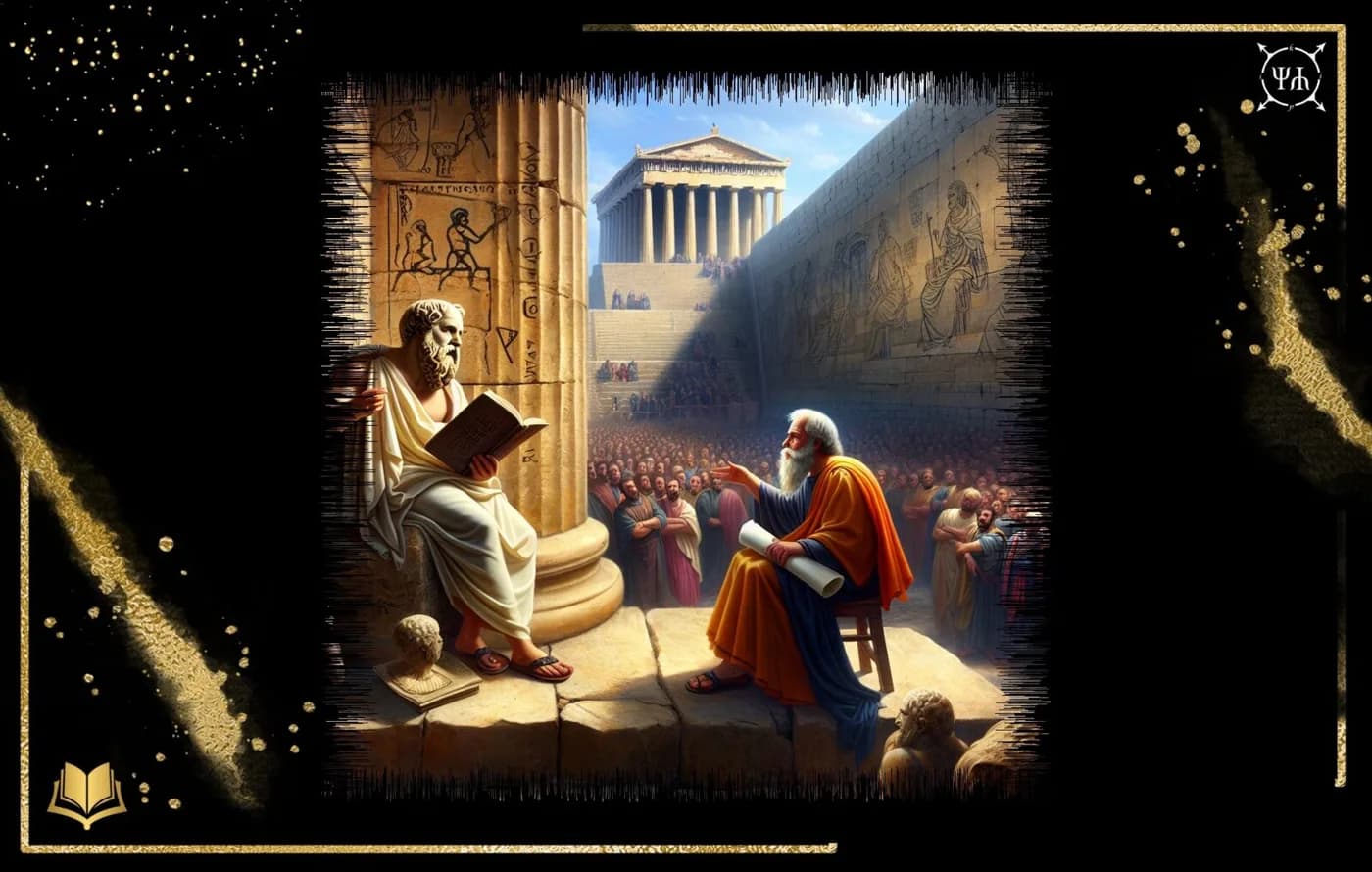
Psychology under lock and key: do we need this law?
Psychology under lock and key: do we need this law? 🔒
But what does the soul feed on, Socrates?
Knowledge, of course, I said.
Only take care, my friend, that the sophist does not deceive us by praising what he sells, like merchants or peddlers who trade in food for the body. They themselves may not know what in their wares is useful or harmful, yet praise everything for the sake of a sale; nor do their buyers know, unless one of them happens to be skilled in gymnastics or medicine. So too those who carry knowledge from city to city and sell it wholesale and retail praise everything they trade in, though some of them may not truly know whether what they sell is good or bad for the soul. If you know what is beneficial and what is not, then it is safe for you to buy knowledge from Protagoras or anyone else; if not, beware of risking what is most precious to you. For there is far more danger in purchasing knowledge than in purchasing food.
(Plato, Protagoras) 📚
This ancient dialogue between Socrates and Hippocrates suddenly sounds frighteningly contemporary. In 2025, Russia 🇷🇺 was going through a historic stage in the regulation of psychological practice. Without diving into every detail — anyone can read the bill itself — the main point of controversy was a provision under which psychological practice would require professional higher education❗❗❗
That became the central subject of debate, triggering intense discussion and even petitions. Some saw it as a necessary safeguard; others called it a restriction on professional freedom. 💬📢
But let's go deeper 💡. Why are there no “paraphysicists” in physics and no “parachemists” in chemistry, while in psychology “alternative specialists” spring up like mushrooms after rain 🍄? Valery Viktorovich Petukhov was already pointing to this problem in the 1990s, describing how science, like a young tree 🌳, can become covered with growths capable of choking it. Psychology is a young science, and therefore especially vulnerable to such growths.
Let's be frank 👁: the market is full of people who simply wear the label “psychologist” while having very little to do with psychology. Some complete a month-long course and call themselves gurus; others have no training at all and provide consultations “by intuition.” Working with another person's inner life while knowing almost nothing about psychology ❓ Yet on the other hand, is a diploma everything? Higher education does not automatically make someone a professional. A real psychologist is not merely someone who has sat through lectures, but someone who lives this work 24/7 — who has not just sprinkled the soul with knowledge, but soaked it in knowledge. As Jung wrote: 🤦🏻
Anyone who wants to know the human psyche will learn almost nothing from experimental psychology alone. He would do better to leave the exact sciences, take off the scholar's gown, say goodbye to his studies, and wander through the world with a human heart: through the horrors of prisons, psychiatric hospitals and clinics, through dreary suburban taverns, brothels and gambling dens, elegant salons, stock exchanges, socialist meetings, churches, revivalist gatherings and ecstatic sects; through love and hate, through passion in every form experienced in his own body. There he will gather a richer harvest of knowledge than a textbook a foot thick can give him, and he will learn to treat the sick with genuine understanding of the human soul.
(Carl Jung, cited in the source used by the author) 📚💡
But life experience is not enough; theory matters too. As my academic supervisor 🫡 writes in her book:
In the struggle for the enormous social demand connected with psychology, extra-scientific and quasi-scientific forms of knowledge — pop psychology and parapsychology — have become increasingly active, broadly and unlawfully using the brand of psychological science to promote their product.
(I. A. Mironenko, p. 137) 📚
🌀 In precisely this sense, an academic psychologist differs from a self-taught practitioner. The latter may try everything at once, without a system of knowledge, logic, boundaries or school — not even “Old School” in the spirit of “Bad Cop,” but rather “my own master” without foundations: castles in the sand, Insta-Therapists 📸. A system of knowledge is Logos: order, a way of distinguishing truth from deception. “If there is no God, everything is permitted,” as the famous Dostoevsky formula goes. Look at Avito — there is no god there, and they treat everything! 😄 And I'm still putting it mildly. If it were up to me, I would introduce the strictest measures against such “healers.” They do not merely make money from someone else's suffering — they sell empty words to people who are desperately looking for help. And if a person receives no real support and then does something irreversible, who is responsible?
🚨 But as the saying attributed to Stalin goes: “If you criticize, propose an alternative.” 📢 So I am not only criticizing; I am stating my own position: the professionalism of a psychologist consists of theory, practice, and above all personal characteristics. As B. G. Ananyev noted:
A person as a subject is characterized not only by their properties, but also by their knowledge, skills, and the technical means of work.
A therapist is first of all a person, and their main “instrument” is their personality. Those characteristics are formed through questioning and searching throughout life. And still the question remains open: do we really need a bill that requires specialized higher education for work in psychology and psychotherapy❓
Do we need clear regulation, or do we risk losing the originality and depth of the profession by forcing it into rigid boundaries❓ 📊
Now the questions are for you:
🔍 Is a psychologist without a diploma finished as a professional — or not necessarily? 🎓❓🔎
Where is the boundary between an amateur and a professional❓ 🔍
Can psychology exist without strict academic education❓
👁 Is it enough to “walk the dark alleys of the soul” to become a good psychologist❓
🌬 Of course, this post is only the tip of the iceberg 🏔️. A social-media format cannot contain the whole depth of the issue, but perhaps the discussion can bring us closer to an answer❓
See the following articles on this topic
Sources 📚
- Plato. Protagoras.
- Mironenko, I. A. The Biosocial Problem and the Formation of Global Psychology. Moscow: Institute of Psychology, Russian Academy of Sciences, 2019. 406 p.
- Hollis, J. Living Between Worlds. Litres, 2022.
#Psychology #Bill #HigherEducation #Psychotherapy #Diploma #Psychologist #Regulation #Discussion #Profession #SelfDevelopment #Jung #Science #Education
━━━━━━━━━━
Read 📚:
- Bill on psychological activity in the Russian Federation
- Once again, on how our word will echo
━━━━━━━━━━
Join the discussion on Telegram or in the VK group 💬
Questions about this article
01Which Russian bill on psychological practice does the post discuss?
It discusses the version of federal bill No. 846497-8 on regulating psychological activity submitted on 20 February 2025, including its education requirements for psychologists.
02Does the author support professional regulation for psychologists?
He recognizes the need to protect clients from unqualified assistance and values theory, practice, and personal qualities, while questioning excessively rigid formal restrictions.
03Does the post describe current Russian legal requirements?
No. It discusses the bill's 2025 version and is not legal advice. Bill No. 846497-8 was later revised, so its current status should be checked in the State Duma legislative system.