 Telegram
Psychopathy, good and evil: what we understood today
Today I was looking at correlations between personality traits and the way people perceive good and evil. Behind the dry statistics, something unexpectedly human begins to show through: when a certain part of the personality becomes too strong, it can change not only behavior, but the very lens through which morality is perceived.
What the data showed
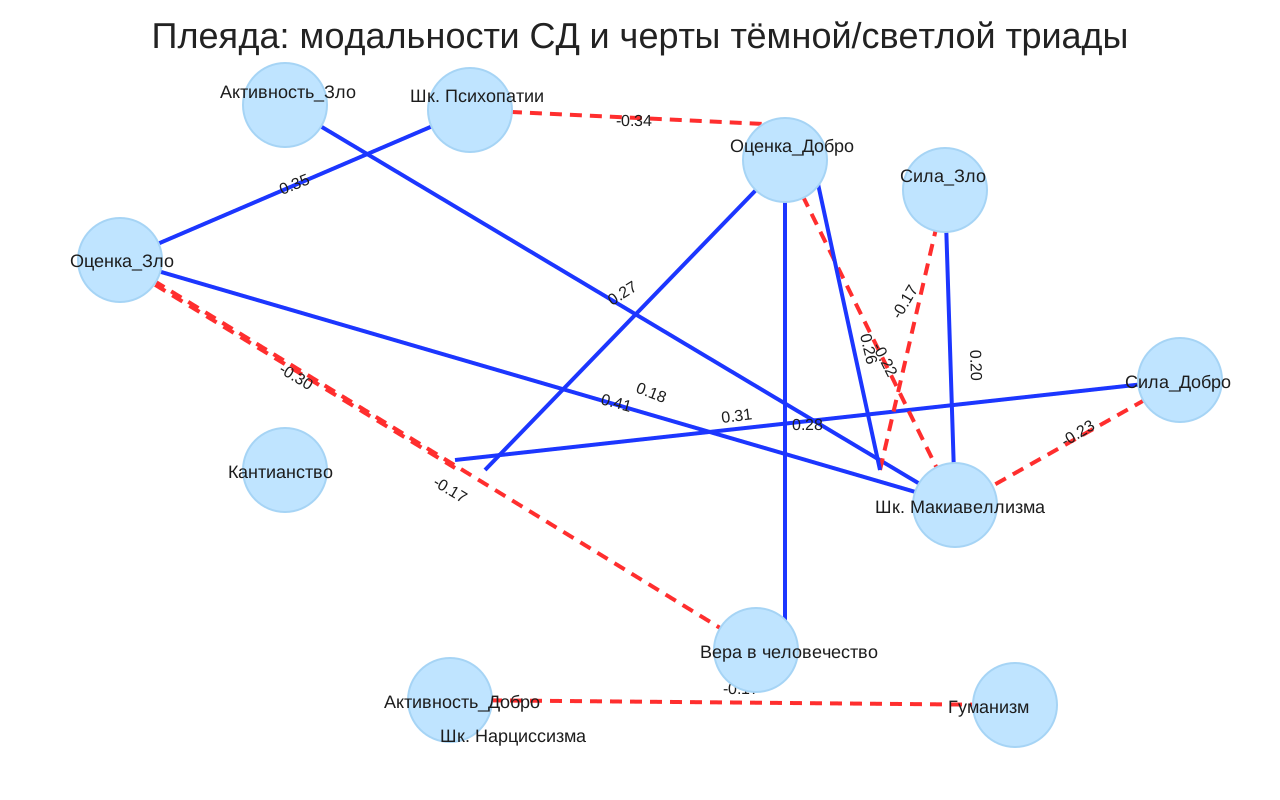
The graph shows that higher scores on the psychopathy scale are associated with higher ratings of evil and, at the same time, lower ratings of good. The relationships are almost symmetrical: a person begins to give evil more weight while perceiving good as something weak or secondary.
Why this matters
It seems to me that a defense mechanism may be operating here. If dark traits are already present in the personality, the psyche may begin to revalue them as something positive in order to avoid an internal split. Put simply: if this is what I am like, then it must be justified — perhaps even good.
This is where I remember an idea associated with Milton Erickson: a therapist cannot begin from contempt for the part of behavior with which a person arrives. If a patient rates evil highly and treats good with distrust, contact must first be established precisely at that point. Without understanding the protective logic, there will be neither alliance nor movement forward.
One more detail
Narcissism behaved differently in this material. It showed no direct relationship with either good or evil, but was associated with a reduced perception of the power of evil. That is a different story: not admiration for the dark, but rather distance from it.
So today's conclusion for me is not reducible to the graph. It is that moral evaluations themselves may also be part of psychological defense. And that means we should work with them not from a position of condemnation, but from a position of precise understanding.
Questions about this article
01How are psychopathic traits related to evaluations of good and evil in the material shown?
In the presented dataset, a higher psychopathy score is associated with a higher evaluation of evil and a lower evaluation of good. This is a correlation, not proof of causation or a basis for diagnosing an individual.
02How does the author interpret this association?
He proposes a defensive-revaluation hypothesis: people may assign more value to traits already prominent in their personality to reduce inner conflict. This is an interpretation, not an established mechanism.
03Why might this interpretation matter in therapy?
The author connects it with the therapeutic alliance: a therapist first needs to understand the protective logic of behavior and establish contact without contempt or premature moral judgment.